How to save a WhatsApp chat for legal purposes
Export the chat from your own phone with WhatsApp's Export chat (include media), keep that .zip exactly as it is, and make a readable PDF whose first page records the file's SHA-256 fingerprint. WhatsApp says it doesn't store messages once they are delivered and its account report leaves them out, so the copy on your phone is the record; keep the phone too.
Why can’t you just ask WhatsApp for the messages?
Because WhatsApp doesn’t have them. Its law-enforcement page says “WhatsApp does not store messages once they are delivered”, and the account report you can request leaves them out: “Account information reports don’t include your personal messages”. The same page says that “To export a copy of your personal messages, you can export your chat history.” The messages live on the phones in the conversation (and in any backup you made), so your phone’s export is the record you have.
Step 1: How do you export the chat in a way that keeps everything?
Use the phone that has the conversation, and include media (WhatsApp’s steps, checked November 22, 2026):
- iPhone: open the chat, tap the contact or group name, tap Export chat, choose With all media, then Save to Files. WhatsApp says the chat “will be exported as a ZIP file”.
- Android: open the chat, tap ⋮ › More › Export chat › Include media, and save every file it offers (Google Drive works well).
Know what the export leaves out. WhatsApp’s help pages say “View once messages will not be exported” (iPhone), and the WhatsApp Web export says “View once and disappearing messages won’t be exported.” If disappearing messages are on, the export holds only what’s still in the chat. WhatsApp export limits lists everything an export can leave out and how to check yours.
Step 2: How do you keep the export file safe?
Treat the .zip (or .txt) as the original:
- Don’t open and re-save it, edit the text or remove files from the zip. Any change gives it a different fingerprint.
- Make copies: email it to yourself, or keep it in cloud storage as well as on the phone. Copies have the same fingerprint as the original.
- Write down when and how you exported it (date, phone, “with all media”). If you have to testify about it, you’ll be asked.
- Keep the phone and the chat. Don’t delete the conversation after exporting.
Step 3: How do you make a readable PDF from it?
A WhatsApp .txt is hard to read: every line starts with a date in your phone’s format, attachments are file names, and iPhone files contain invisible characters. Choose the export below and the tool turns it into a PDF with a summary page, every message numbered with its sender, date and time, and the photos inline.
Turn a WhatsApp chat export into a PDF
Get the file: in WhatsApp, open the chat. iPhone: tap the contact or group name, then Export chat. Android: tap ⋮ › More › Export chat. Choose with or without media and save it (on iPhone, Save to Files). Then choose the .zip or .txt here.
Get the file: on Android, the free SMS Backup & Restore app saves your texts as an .xml file (its name starts with sms-). Choose that file here. Big backups with photos are fine: the file is read in small pieces, on your device.
Get the file: in Instagram or Facebook, go to Accounts Center › Your information and permissions › Export your information › Create export › Export to device. Pick Messages and set Format to JSON. When Meta's email arrives, download the zip and choose it here (if there are several zips, choose them all).
Get the file: in Telegram Desktop (on a computer), open the chat, click ⋮ › Export chat history, and set Format to Machine-readable JSON. Choose result.json here, or a zip of the export folder to include photos.
No export on iPhone? Take screenshots of the conversation (side button + volume up), then choose them here. Each one goes on a page in order, with its file name, date and SHA-256 fingerprint. Text in the screenshots is not read or retyped.
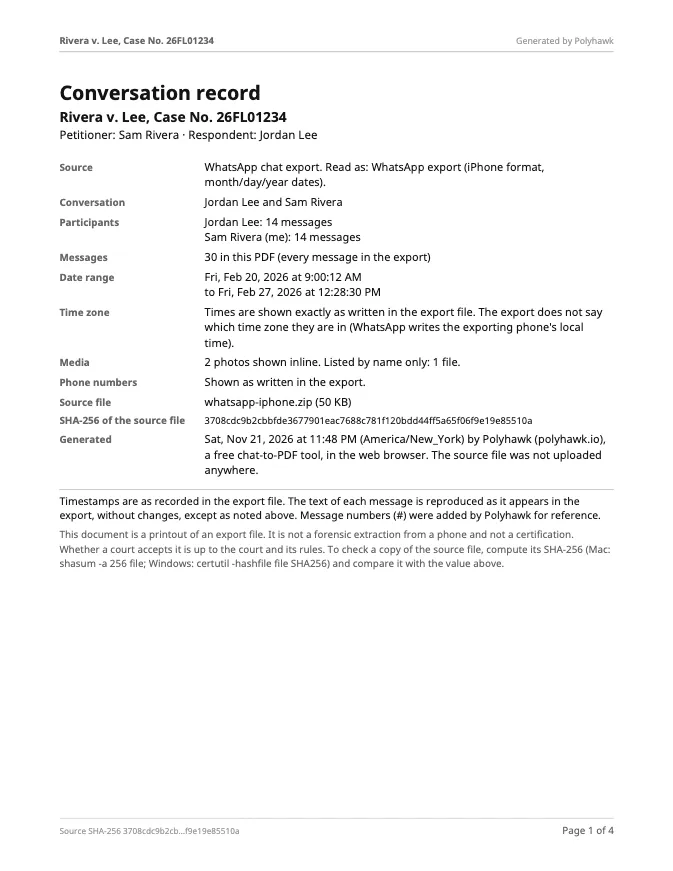
What page 1 will say
Preview of the messages
Pro is coming soon · $9.99 per export or $24.99 lifetime
- The clean PDF, with no “Preview” watermark on its pages
- A one-time price, no subscription
- Every source: WhatsApp, Android texts, Instagram, Messenger, Telegram, screenshots
Everything above is free while we launch. Leave your email and we'll write once, when Pro is ready.
Runs in your browser. Nothing is uploaded. No sign-up.
The PDF’s first page records:
- the export file’s name and size, and its SHA-256 fingerprint, computed in your browser;
- the participants and how many messages each sent, the first and last date;
- a plain statement that “Timestamps are as recorded in the export file” and that WhatsApp’s file doesn’t say which time zone they are in;
- what media is included, and anything WhatsApp left out (shown as “omitted” in the file).
Every page carries your case title (if you add one) and “Page X of Y”. In our test, a 30-message iPhone export with two photos became a 4-page PDF in 0.2 seconds. Use the date range only when you mean to: courts often prefer the whole conversation, and page 1 says when a range was applied.
Step 4: What does the fingerprint do?
A SHA-256 fingerprint is a 64-character code computed from every byte of a file. Change one byte and the code changes completely. Anyone can recompute it from your export to confirm it’s the file the PDF was made from:
- Mac: open Terminal and run
shasum -a 256followed by the file. - Windows: in Command Prompt, run
certutil -hashfilefollowed by the file andSHA256.
In US federal courts, Rule 902(14) of the Federal Rules of Evidence covers data “copied from an electronic device, storage medium, or file, if authenticated by a process of digital identification”. The committee note explains that such copies are “ordinarily authenticated by ‘hash value’”. But the rule also needs “a certification of a qualified person” and advance notice to the other side, so a fingerprint on a PDF does not by itself make the PDF self-authenticating. State courts have their own rules. Think of the fingerprint as a way to show your PDF and your export match, not as proof the messages are genuine.
What makes a WhatsApp chat weaker as evidence?
Self-help guides for courts point to the same problems again and again: cropped screenshots, single messages pulled out of a longer exchange, missing context, and no one able to say where the copy came from. A guide from the resource center of the National Council of Juvenile and Family Court Judges notes that “Courts often want to see entire conversations.” A complete export, a PDF made from it without changes, and your phone kept safe address all of these.
How to present text messages in family court covers copies, exhibits and authentication. If the same person also messaged you on Instagram, the same steps work with Instagram and Messenger to PDF; for iPhone texts, see How to print text messages from iPhone for court.
Questions people ask
Is a WhatsApp chat admissible in court?
It can be, but that's for the court to decide under its own rules. Courts generally want to know that the messages are what you say they are: usually a participant testifies about them, and the other side can question whether the copy is complete and unedited. An untouched export, a PDF made from it and the phone itself make that easier to show.
Can WhatsApp give me a copy of my messages?
No. WhatsApp's help page says "Account information reports don't include your personal messages", and its law-enforcement page says WhatsApp "does not store messages once they are delivered". The help page points you to exporting your chat history instead.
Should I export with or without media?
With media, if any photos, videos or voice notes matter. Without media, WhatsApp writes only a placeholder where each one was ("image omitted" on iPhone, <Media omitted> on Android), and the files can't be added back later.
Will the other person's export look the same as mine?
Not exactly. Each export uses its own phone's clock and date format, so times can differ by a time-zone difference, and messages either of you deleted for everyone show as "This message was deleted".
Does the SHA-256 on the PDF prove the chat is real?
No. It proves which file the PDF was made from: anyone can recompute the fingerprint of your export and compare. Whether the messages themselves are genuine is shown in other ways, usually testimony from someone who took part.
Can I save someone else's WhatsApp chat?
Only chats you are part of, from your own phone. Getting into another person's phone or account without permission can be against the law, and this site won't help with it.
Polyhawk is not a law firm and does not give legal advice. Whether a court accepts a document is up to the court and its rules; ask a lawyer or your court's self-help center.
Related
- WhatsApp to PDFTurn a WhatsApp export (.zip or .txt, iPhone or Android) into a PDF with every message, date and time, photos inline and page numbers. Nothing uploaded.
- Texts in family courtPrint the whole conversation with numbers, dates and times, bring the copies your court asks for, and be ready to say it's accurate. With official sources.
- iPhone texts for courtThe iPhone's Messages app can't print or export a conversation. The three ways that work, checked on Apple's iOS 27 guides, and what courts look for.
- Instagram and Messenger to PDFDownload your messages from Meta in JSON, then turn one Instagram or Messenger conversation into a dated PDF with photos. Free, nothing uploaded.
- All guidesEvery Polyhawk guide, by task.